Wednesday, July 8, 2009
Got Cucumbers? Skin Care Rx
Good Morning! It has been a busy time with our foster girls this week - 4th of July parade and fireworks, Amish country, some great discussions, crafts, and more! Hope you're having a good week so far. :)
Here's some interesting cucumber information I found and thought might come in handy sometime ...
Besides being a refreshing veggie loaded with vitamin C, vitamin A, potassium, and dietary fiber, cucumbers have healing properties for your skin!
You've heard the expression "Cool as a Cucumber" - it's no joke! The inside of a cucumber is up to 20 degrees cooler than the outside.
That's why it feels so good to put cucumber slices over your eyes to reduce puffiness. You can also use them to put on minor burns or other skin irritations. How does it work? Cucumbers contain a natural astringent which causes blood vessels to constrict, decreasing swelling.
For skin rashes, insect bites, sunburns, and minor aches, chop cucumber skin and flesh in your blender and spread the paste over the affected area. This paste can also be used to make a homemade skin mask - it brings out the natural shine and beauty of your skin.
Aren't cucumbers amazing?
(Resources: Better Homes and Gardens, February 2009, p. 106. Uses for Cucumbers. The Many Uses of Cucumbers)
Comments? Click here to comment on the original blog.
Similar topics:
Organizing Your Herb Garden, Part 4 - Using Your Herbs for Healing
Reduce Anxiety with These Foods
Mouthwash and Mosquitoes


Tuesday, July 7, 2009
National Association of Professional Organizers' Best Product in Technology
The National Association of Professional Organizers awarded NeatDesk their “Best Product – Technology” at their annual conference this year. I thought you might like to know about it. I have not tried it, but it looks pretty cool. It costs $499, but they are offering $50 off right now. Here's what NeatDesk's website says about it:
Paper goes in. Information comes out.
NeatDesk is a high-speed desktop scanner and digital filing system that scans receipts, business cards and documents all in one batch. It includes NeatWorksTM software that identifies and extracts the important information and automatically organizes it for you.
With NeatDesk, you get a digital filing cabinet that intelligently organizes and secures all your important information.
Transform your workspace into a space that works. At work or at home, NeatDesk declutters your workspace, providing a central “inbox” for all your papers—ready to scan when you are.
All-in-one scanning. Our removable input tray can scan both sides of up to 10 receipts, 10 business cards, and 10 documents at a time—or even a single, 50-page document.
Key Features:
Intelligent Text Recognition
NeatWorks software uses OCR and patented parsing technology to identify and capture key information from scanned documents. On receipts, it looks for the date, vendor, amount and sales tax. On business cards, it captures all of the contact information: name, company, title, address, phone, email, website and fax. And on documents, the software captures all of the printed text and gives it to you in searchable PDF format. You can also perform keyword searches on any scanned item to find what you need quickly and easily.
Scan in receipts to:
- Save digital copies of receipts and records of vendors, dates and totals
- Create expense reports and manage business and personal expenses
- Keep track of expenses for tax time (records accepted by the IRS)
- Export data to Excel®, Quicken®, QuickBooks®, TurboTax®
Scan in business cards to:
- Keep digital images of cards and contact information
- Capture name, address company, title, etc.
- Create your own searchable contact database
- Export data to Outlook and more
Scan in documents to:
- Create searchable PDF files
- Edit text using copy/paste
- Organize and store in your digital filing cabinet

Monday, July 6, 2009
Organizing Your Mud Room
Hope you had a great 4th weekend! We did, and we're headed off to Amish country today.
This was a guest post I did at I'm An Organizing Junkie, but I never posted it here. So ... here it is, with a little revision! The picture was added, compliments of Laura, The Organizing Junkie:
Organizing Your Mud Room
I love mudrooms! They corral clutter before it enters your home! If you don’t have a mudroom, you can even create one in your garage or a hall closet.
Whether your mudroom is inside your house or in the garage, the idea is the same – you want to have a dumping ground as your family enters the house. Start with pegs or hooks to hang backpacks, briefcases, coats, scarves, etc. If you have room, add a bench with storage to sit on while taking off shoes. A chair will suffice, too.
The bench can house sports equipment if you have athletes in the house. Or choose another receptacle for sports equipment. And finally, shoe storage – a shoe rack, shelves, cubbies, etc.
A rug from the bench or chair to the door is a nice touch, if your mudroom is in your garage. If the members of your family are slipper wearers, they could keep them in the mudroom and slip into them after removing their shoes.
By creating such a mudroom, your house doesn’t look like it has exploded when family members come home. It takes a little training to get everyone to put things on hooks or in the shoe or athletic storage, but it is worth the effort! Every few days, have a shoe exchange where everyone picks up an armload of their shoes and takes them to their closets.
Whoever invented mudrooms was ingenious!
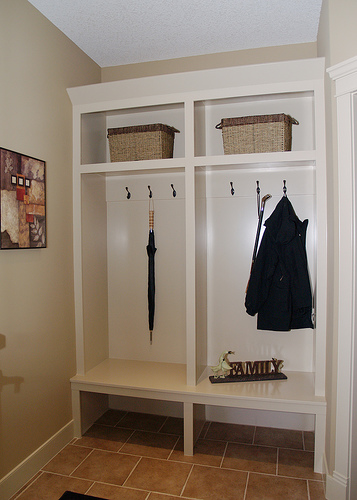
photo courtesy of dennace
What have you done to make your mudroom work? Subscribers click here to comment on the original blog.
Similar topics:
Get Organized Month 2009: More on Closet Organizing - The Closet Purse Hanger
Get Organized Month - Declutter Your Linen Closet
Get Oranized Month 2009 - Organizing Your Clothes Closet
Friday, July 3, 2009
Using Your Drive Time Efficiently
Happy Friday! And happy 4th of July! We plan to go to a parade and see local fireworks. Hope you have a great weekend. :) Here are some thoughts I had about using your drive time well ...
Life is busy! And our time is finite. If we use our time well, life is less chaotic and we have more time for things we love. Here are a few tips:
Using Your Drive Time Efficiently
Life is busy! And our time is finite. If we use our time well, life is less chaotic and we have more time for things we love. Here are a few tips:
- Travel during non-peak traffic hours whenever possible.
- If flexible hours are offered at work, and it works for you, start your work day earlier or later than normal, saving hours by driving at off times.
- Carpool or ride public transportation if possible, using that time to do something else.
- If possible, work from home one or more days a week, eliminating commute time.
- Save up errands, rather than running out several times a week. Write them down so you don't forget them.
- Pre-plan errands – combine errands and appointments in the same area to reduce drive time or repeated trips. Add on errands before or after times when you are out anyway.
- Listen to a recorded book or seminar, podcast, etc. while driving.
- Capitalize on the time spent stopped at lights - file your nails, remove trash from car receptacles, make a list, listen to the news, read a few paragraphs in a book, do deep breathing exercises, butt crunches, or finger exercises, etc.
- While shopping, if you find something you know you will need in the future, buy it, rather than having to make another trip later.
- Try to find doctors and other professionals near your home or workplace to reduce driving time. Do the same with shopping and restaurants.
- Share driving responsibilities with other parents for team practices/games, youth group, etc.
- Keep your car in good working order, preventing emergencies, missed appointments and wasted time.
Similar topics:
10 Ways to Double Your Time
Organize Your Shopping Trips
Restorative Moments and Margins
Thursday, July 2, 2009
Helping Your High School Graduate Make an Intentional Plan for Transitioning into College Gracefully
Good Morning! We have girls coming this morning. One of them has graduated from high school and will be heading off to college in less than two months. Going to college is scary the first time! So I thought I'd chat with her about transitioning into college gracefully.
We usually go out to coffee together to have some uninterrupted time together when she's here. I want to ask her how she can make her transition into college a positive one, even though she has a bunch of emotions going on.
She is scared. I want to mention that everyone is scared when they go to college. Just voicing it out loud makes it not so scary. And to know that it's normal helps, too. My own children were scared and excited at the same time, and they had far fewer hurdles to climb than our foster girls have had.
She's be anxious to have freedom! To be a guardian of the county carries with it many guidelines and restrictions. Just to be able to call a friend, their social worker must interview the friend and family! I want to talk to her about the pendulum - how she wants to maintain the same values she has maintained this year and not go to an extreme in the opposite direction just because she can.
I've seen many college students who come from rather controlling homes go crazy their first year in college because they don't know how to handle their freedom. They haven' t been trained in how to make decisions, use discernment, or manage their time. During our girls' last year in high school, we tried to give them more control: we stopped asking if they had homework and such to prepare them for the total freedom they would have in college. We still expected to know where they were and when they'd be back, though. :)
She is so done with the childishness of her peers and siblings. Our girls were ready to move on from the beginning of their senior years! Everyone else at school seemed so petty and immature! I want to talk with our foster daughter about leaving well for the sake of the younger girls in her house. She is setting an example for them - hopefully a graceful one - on transitioning.
Many times our foster girls don't have the luxury of smooth transitions. Their parents do ridiculous things which are unpredictable, and create unpredictable lives for our foster daughters. They are yanked from their homes, schools and neighborhoods. Sometimes over and over. So smooth transitions don't come naturally.
I want our foster daughter to keep the younger girls in mind as she is transitioning - that they are the ones being left, that they will miss her, that they are looking to her as a role model.
She is stressed. There is so much to do before leaving for college! I want to help her think through what her tasks are before leaving: packing, shopping, paperwork, etc. To plan out those tasks will relieve the stress of being rushed at the last minute. I want to help her remove any chaos that doesn't need to be in her life during a very chaotic time.
She is insecure. She is probably wondering if she will be successful in college. She has already changed her major several times this year! I have gone over the Myers-Briggs personality inventory with her to pinpoint what is important to her in a vocation. So that is a huge tool in her tool belt.
I also want to work through my Three Steps to Time Management for the College Student with her to help her determine her own passions, priorities, and gifts. In doing so, she will be confident going into college because she will know what is important to her. And can measure opportunities that arise in light of her own priorities. She will be able to plan her schedule to include her own goals, rather than be at the whim of others. She will be less likely to flounder.
So ... we have a lot to talk about! If you have a child going into college, help make that transition graceful! Tears come, but that's normal, too. :)
Comments? Email subscribers click here to comment on the original blog.
More blogs about college:
Organizing For College - Dorm Room
Organizing for College - Guest Blogger Sarah Scrafford
Packing for College, Round 1
Wednesday, July 1, 2009
Shadow Boarding Your Tools
Hope your summer is going well! We are having a bumper crop of raspberries this year! I love it!
Here's a re-post of a one I did last summer:
Now that the weather is nicer, you may be spending more time outside and using the tools in your garage more often. One way to make sure your tools get put back in the correct spots is to do what the professionals do - shadow board your tools.
Shadow boarding consists of tracing the outline of your tools with a marker or paint onto the pegboard or wall where they hang. This is especially helpful if you have other people using your tools. Even a child can see where to replace a tool once it is used.
If you loan out your tools to neighbors, family, etc., you may even want to keep a list of who has borrowed which tool and when. Then if one turns up missing, you'll have a record of where it might be rather than having to remember who may have borrowed it.
Comments? Subscribers click here to comment on the original blog.
Other Garage blog posts:
Spring Cleaning the Garage - Storing Hazardous Materials
It's that Time Again - Swapping Out Your Seasonal Tools
Storage for Your Garage
Tuesday, June 30, 2009
Getting the Maximum Mileage out of Your Veggies
I don't know about you,but I get bored with the same things all the time. So I try to be as creative as possible with whatever veggies I have on hand for the week in order to save money and not bore everyone to death!
Using the same veggies, you can serve:
- a veggie tray
- grilled veggies in foil using salad dressing for a marinade
- a tossed salad or dinner salad
- a salad comprised of cut-up veggies tossed in Italian, ranch, etc. dressing (no greens)
- stir fried veggies - add some meat and it's a meal
- steamed veggies.
At the beginning of the week I usually buy a veggie tray from Sam's. With such picky eaters as our foster girls, it's nice just to put the tray on the table and let everyone choose what they want. The price is so reasonable ($10), and I don't have to do the chopping!
Depending on which girls are here, I'll take veggies they like and place them in foil and drizzle Italian dressing over them. Fold up the foil into a packet and grill about 15 minutes on medium. Broccoli cooked this way was a big hit. This week while we've been off, I combined asparagus and mushrooms. Squashes, peppers, and onions are great candidates for grilling, too.
Small potatoes can be wrapped in foil and grilled for about half an hour. When my husband turns on the grill to sear the meat on high, he puts the potatoes in at the same time and then turns down the heat for the rest of the cooking time. We have also made foil packets with thinly sliced potatoes. You can just add butter and salt and pepper or mix dry onion soup with oil (the recipe is on the box). They take abut half an hour, too.
This week my veggies were carrots, cucumbers, asparagus, grape tomatoes and mushrooms. These can all be used in a tossed salad. Or made into a dinner salad if you add your choice of meat, cheese, nuts, beans, or seeds. I enjoy adding fruit, too - apple, grapes, pears, dried cranberries, mandarin oranges, or berries. When the girls are here, I set the ingredients out and let everyone make their own salads according to their tastes.
One day this week I chopped cucumbers, asparagus, grape tomatoes, mushrooms, a tad of onions and tossed them with Asiago cheese salad dressing. The dressing's strong flavor was a great compliment to the mild taste of the veggies.
Stir fry is a great option when you have small amounts left of several veggies. I start with some of my Teriyaki marinade as a cooking sauce. Next I add the veggies that need to cook longer (carrots, onions, green beans, cabbage) followed by those that need to cook less (mushrooms, peppers, brocccoli, snow peas). If I'm going to make it a meal, I add cooked meat with the second batch of veggies. Serve a plate of fruit and dinner is done!
Steamed veggies are always a stand-by. My favorite seasoning for fresh green beans is garlic salt and butter. Same with cabbage. Really brings out the flavors.
After you've tried all these variations and you still have some fresh or cooked leftover veggies that no one wants, put them in the freezer for soups in the winter. Do the same with bits of meats, rice or beans, and you have a free meal one night!
Comments? To comment on the original blog, click here if you're a subscriber.
Similar topics:
Quadruple Batch of Teriyaki Marinade
Who Invented Meatloaf Anyway?
Grill Your Entire Meal
Monday, June 29, 2009
Expert Organizing and Design Tips for Your Foyer

(Photo by Eric Roth)
I came across this article in the Boston Globe Magazine featuring tips from architects and interior specialists. I thought it contained some great organizing and design ideas. Here's the article:
"Designer Tricks for the Foyer
by Marni Elyse Katz and Deblina Chakraborty June 12, 2008
by Marni Elyse Katz and Deblina Chakraborty June 12, 2008
Architects and interior specialists share their secret sources, strategies for clever styling, organizing tips and other home updates you can do yourself.
Place everything. That chest of drawers just sitting there in an upstairs bedroom would make an excellent hall table, says Sudbury's Sarah Desmond. Use it as storage and switch out mittens for flip-flops as the seasons change.
Reflect on you. Supply grandeur in a small foyer without taking up much space by adding a floating shelf and a mirror, suggests HGTV.com's Taniya Nayak. She suggests hanging a Lack shelf from IKEA between 36 and 42 inches off the floor, with a mirror (she likes the selection at HomeGoods) above it.
Smarten up. Sarah Desmond suggests another way to show off your style while organizing your stuff: Repurpose useful items you have around the house. A planter you like, for example, can be an umbrella caddy, or a champagne bucket can hold mail.
Frame someone. Architect Stephen Chung pieced together an interesting portrait of his son Jet in their home's entry. He took a series of photographs of Jet, each focusing on a different area of the body, then pieced them together. You could also create a whole "person" with the knees, face, and torso of different family members, for example.
Punch up the door. Add a bright splash of color to your foyer by painting the inside of your front door, says This Old House correspondent Carole Freehauf. Or, to make a door you don't want to play up disappear, stick with a neutral color or match the walls and trim. "But if you love apple green," she says, 'why not?'"
Are you proud of some of your design or organizing tricks? Let's hear them! Subscribers click here to comment on the original blog.
Similar topics:
Your Priorities, Passions, and Gifts Create Context for Your Clutter
My Guest Blog on Creating a Mudroom
Clever Organizing Tips from Better Homes and Gardens
Finding More Bathroom Storage without Expanding Your Bathroom
Sunday, June 28, 2009
Organizing Sales
I saw that Sterilite containers are on sale at Target this week and thought I'd pass it along to you. These are the containers I use to help people downsize to smaller residences. I also use them to store Christmas/seasonal decorations and other stored items. I use the 70-quart containers which are on sale for $7.99 rather than $11.99. If you are looking for some sturdy, waterproof, bug-proof containers, these are great!

 |
I also saw this organizer which is on sale for $9.99, which I thought was a good price.
The Container Store is having a college and travel sale as well.
Just thought you might like to know!
Saturday, June 27, 2009
How Paris Hilton Organizes her Closet
Thought you might like to see how Paris Hilton organizes her closets - yes she has one just for jewelry!
Friday, June 26, 2009
A Dozen Ways to Take the Stress out of Big Projects
We all have big projects we must accomplish at different points in our lives. It may be a normal part of your job or a fund-raiser for your child’s sports team or doing a home improvement project. Whatever the case, if you plan ahead, you can eliminate much of the stress that could accompany a big project. Here are a few tips:
1. Break down your project into categories and then to specific tasks in each category.
2. Estimate the time it will take do each task. Err on the side of over-estimating rather than under-estimating.
3. Add up the time it will take to complete your project so you will know how much time will need to be devoted to the project.
4. Set a deadline for the completion of your project.
5. If your project allows, delegate. Assign tasks with clear instructions and deadlines. Plan to follow-up periodically.
6. Working backwards, schedule the specific tasks/deadlines and follow-ups, allowing some extra wiggle room for unexpected delays. Plan to finish your project a couple of days ahead of schedule to reduce your stress level.
7. Know your peak energy times and schedule your tough jobs then, if possible.
8. Do big projects during big chunks of time and small ones during small scraps of time.
9. Do projects that require concentration at times when you won’t be interrupted at a place where there are few distractions. If you work in an office, consider going in during an evening or weekend when no one else is there. Make sure to take some time off during the week to compensate yourself.
10. Inform others of times when you do not want to be interrupted and when you will be available. Record this information on your voice mail. Give polite, but firm reminders when you are interrupted during your no-interruption times.
11. If necessary, go to a location away from your office or home where you are unlikely to be disturbed.
12. CELEBRATE the completion of your project!! If others are involved in your project, make sure to involve them in the celebration.
Comments? Click here to comment on the original blog post.
Similar topics:
Interesting Clutter and Organization Statistics
Reduce Your Stress - Say No
Helping Your Child Organize Large Homework Projects
Thursday, June 25, 2009
Packing for College, Round 1
If you have a child going off to college, it's not too early to think about doing a little packing. By doing some preliminary sorting and packing, it greatly reduces the stress when it's time to pack up and go to college! The following is a revised version of a blog I did a couple of years ago when one of our foster daughters was getting ready to head off to college....
Yesterday I helped one of my foster daughters pack for college. Since she is going to be around for another month, this was the first round - it took three of us about 3 1/2 hours. I asked her questions about each item, she and I sorted them into categories, and another person folded clothes and later packed the sorted items. We sorted into several categories - toss, give, store, will take but don't need it until then, and will take but will use between now and then.
Those things she tossed and gave away were cleared out of the room - it gave us more space to work. We packed in clear plastic 70 qt. containers and slipped a piece of paper down the side of each container listing the contents. This will allow her to see the list as well as what is inside.
We packed clothes and shoes she didn't need now in a couple of containers. Winter clothes were packed separately since they won't be used for a couple of months. We put school supplies in a container by itself. Another container holds extra shampoos, mouthwash, toothpaste, toilet paper (I can't believe her school doesn't provide it!!!), etc. Towels and other miscellaneous belongings went in another, and so on.
We also organized stacking drawers she will take for her dorm room - one for electronic things - camera, ipod, wires, batteries, etc. One for important papers. One for daily cosmetics/hygiene stuff. And a set of smaller drawers for little items. She'll pack her remaining items in her suitcases when it's time to go off to college.
By doing the initial packing ahead of time, she was able to get rid of a big job and have peace of mind that it's done. She can now take inventory to see if there are things she still needs to get. And she will have enough time to do it without being rushed. Her room now contains only what she will pack up to take to college, or leave behind.
If you have a child going off to college for the first time, make sure to look at the list the school sends you. Work ahead to purchase the things your child needs and to do an initial packing of his/her room. This will provide a pleasant memory for your child as he/she prepares to leave home, rather than a hectic, last-minute scramble. Going away to college is scary enough without having additional stress!
Comments? Email subscribers click here to comment on the original blog post.
Some other college topics:
Organizing for College - Guest Blogger Sarah Scrafford
Great info for college students, their parents, and college professors
Organizing For College - Dorm Room
Wednesday, June 24, 2009
Organizing Your Herb Garden, Part 4 - Using Your Herbs for Healing
I did a series on herbs last summer and decided to add to it today. I came across this article about the healing properties of herbs by Dr. Mao. While I do not embrace everything he stands for, I thought this article was very helpful.
"Herbs have been part of every culture and medical tradition since the earliest humans walked the earth for treatment of everything from colds to digestive issues to depression. You may be surprised to learn that the herbs you have been regularly using to infuse your food with appetizing flavors also have amazing healing abilities. They are easily grown in your own home so you can have them on hand to use whenever the urge to cook strikes you. Read on to find the healing health benefits of these commonly used herbs.
1. Rosemary
Rosemary has been used as a brain tonic in Chinese traditional medicine for thousands of years. Rosemary contains volatile oils that help stimulate brain activities and increase brain alertness. One compound it contains, cineole, has been found to enhance the ability of rat to navigate mazes. So skip the harsh coffee and spice up your energy level with rosemary. Other benefits? Rosemary also aids in digestion and perks up your immune system. Steep it as tea, use in your poultry dishes and soups--or just crush some up to fill your home with an energizing scent.
Growing tips: Rosemary needs to live in a very sunny window and may even need supplemental light. It is sensitive to overwatering so keep it on the dry side.
2. Mint
Peppermint, spearmint, and other mint-family plants are considered one of the most versatile herbs in traditional Chinese medicine. Peppermint has many well-documented properties: It increases healthy gastric secretions, relaxes the intestines, soothes spasms, settles the stomach, and alleviates gas. In a culture marked by poor diet and digestion--and the heartburn that comes with it--peppermint can be your best friend. Additionally, peppermint is rich in antioxidants that support good vision and also cleanses your liver, helping to eliminate harmful toxins from your body. Steep peppermint as a tea and drink it a half an hour after mealtimes for untroubled digestion.
Growing tips: Mint is an easy-to-grow herb that is invasive, so be sure to grow it in its own pot.
3. Oregano
When you're suffering from cold or flu, steep oregano in a pot of water and inhale the vapors, which are antibacterial, antiviral and decongesting. This immunity-enhancing herb also settles digestion and prevents bloating.
Growing tips: Oregano needs a lot of light to grow so find a window with direct light or grow out-of-doors.
4. Sage
Chinese traditional medicine has long used sage to help prevent the loss of mental function that comes with age. Sage has been found to increase oxygen to the brain cortex and to help improve concentration. Sage is easy on the digestion. Cook it up in soups and poultry dishes.
Growing tips: Sage can be a bit difficult to grow. It is very sensitive to overwatering because it is more susceptible to mildew than other herbs.
5. Chives
A member of the garlic and onion family, chives have been used throughout history for natural healing because they contain a substantial amount of vitamin C as well as essential minerals such as potassium, calcium, iron and folic acid. In Chinese medicine they are used to clear stuffy noses, prevent bad breath, ease stomach aches, strengthen the lower back, and improve poor circulation that gives you cold hands and feet. Some serving suggestions? Chop up chives and add them to stir-fries or mix in with ground poultry to stuff ravioli or dumplings.
Growing tips: Chives are fairly easy to grow because they don't require as much light as other herbs.
6. Basil
A favorite herb in Italian cooking, basil's scent can perk up your energy level and it is filled with luteolin, a bioflavonoid that studies have shown to be the best protection of cell DNA from radiation.
Growing tips: Basil can be more difficult to grow. Your best bet is to grow it during warm, bright summer months.
7. Cilantro
Cilantro is an energy tonic that can boost your immune system and smooth out your digestion. Use it in your cooking to get its health benefits.
Growing tips: Cilantro, the name for the stems and leaves of the coriander plant, can be hard to grow. Sow the coriander seeds in a thick concentration in a shallow tray.
8. Parsley
Parsley is used in a Chinese folk remedy for cooling the liver and clearing the eyes. Parsley is packed with luteolin, and there is some evidence that this helps protect the eye from UV radiation damage and from glycation, a process in which sticky sugar molecules bind up protein, potentially damaging the retina. The age-old folk remedy recipe for vision protection is a juice blend of celery, peppermint, and Chinese parsley, made fresh daily.
Growing tips: Parsley doesn't need very much sun, but it is a slow grower, so don't expect a high yield.
Herbal Tea Recipes
Aside from use in cooking, all of the above herbs can be used to make aromatic potent teas. You may use the herbs individually or experiment with combinations. For example, to make a tea that soothes digestion and prevents bloating: Steep 1 teaspoon each of mint, rosemary, oregano, cilantro, sage and basil and in a cup of hot filtered water for five minutes. ...
Grow Your Own
To grow your own herbs, all you need is some terra cotta pots with drainage holes, high-quality organic potting soil, and a window sill that gets at least six hours of light per day. A southwestern-facing window is your best choice for good light. If this isn't possible, you can get a few clamp-on reflector lights with compact fluorescent bulbs and place them about six inches away from the plant.
Keep in mind that overwatering is the biggest mistake people make when trying to grow herbs inside. The rule of thumb is to let the herbs dry out completely, and then water. Beginning with baby plants will be less troublesome than starting from seed. With practice, you will learn the best ways to grow and care for your indoor herbal garden."
Comments? Click here to comment on the original blog post.
Other posts on herbs:
Organizing Your Herb Garden
Organizing Your Herb Garden, Part 2 - Drying Herbs
Organizing Your Herb Garden, Part 3 - Using Your Herbs
Herb Recipes
Tuesday, June 23, 2009
Cook It Once, Serve It Twice
I'm back from the gym and feeling proud of myself for going when I didn't want to!
I'm also happy because I already have dinner covered for today. Lunch actually. While we're off, we're eating our big meal at lunch time. It really seems to work better with my appetite and energy.
I'm a morning person and am hungrier and have more energy at the beginning of the day. And my husband is enjoying the change, too. Even when I know what I'm cooking for dinner, by 4 pm I have trouble getting up the desire to cook! (Not that it matters - I have to cook anyway!)
So back to lunch. Lately I've been trying to cook extra meat one day and serving it twice. On the second day I turn it into something else - especially nice for those who don't like leftovers.
So two nights ago my husband grilled a bunch of chicken. We had leftovers yesterday, but today the chicken is going into stir-fry. Last week I marinated chicken in a Hawaiian marinade. We had the chicken one night and I created a Hawaiian salad the next night (greens, chicken, pineapple, grapes, red peppers, cucumbers, onions, sesame seeds, grated cheddar, sliced almonds). I even came up with a Hawaiian salad dressing to go with it! Yum! It was a hit with the girls.
When we grill steaks, I remove the extras before they go to the table - so we will actually have leftovers! Both chicken and steak can be turned into fried rice, stir-fry, fajitas, or wraps.
Just another way to save time in the kitchen - especially during the summer months!
Do you have similar time-saving tips? Click here to comment on the original blog if you're an email subscriber.
Other Time- and Energy-Saving Cooking Tips:
Grill Your Entire Meal
Dinner in 15 - A Grilling Twist
Quadruple Batch of Teriyaki Marinade
Monday, June 22, 2009
An Emergency Entry on Your Cell Phone
Good Morning! Hope you had a nice weekend. We are off as of last Friday around 6 pm. Over the weekend, we got the house ready for the next girls, played Settlers, had sushi, went to church, made a list of what we want to do while we're off, talked to our dads and our children, and did some grilling, shopping, laundry, and napping.
Here's what I'm thinking about today:
An Emergency Entry on Your Cell Phone
This morning I needed to pick my husband up from the car mechanic after going to the gym. I hadn't taken my cell phone with me and was debating whether to swing by the house on the way. I decided to do it.
I got to thinking ... What if I had a car accident on the way and didn't have my cell phone? What if I were unconscious, how would they contact my husband if he were not at home or at the office? I can't remember if we put our cell phone numbers on our information when we renewed our drivers licenses. (As you can see, I have a very active and vivid imagination!)
On the outside chance someone might pick up my cell phone and try to figure out who to call, I now have an entry called "emergency numbers" with cell phone numbers for my husband, daughters and son-in-law.
I know this is a morose subject, but I have more peace of mind when I'm prepared for the unexpected. I tried to think of ways someone might abuse or misuse this entry, but I couldn't come up with anything. I don't know if it's a silly idea, but it's done. :)
What do you think? If you subscribe by email, comment by clicking here to be taken to the original blog.
Other safety topics:
Organize an Emergency Kit for Your Car
National Preparedness Month - Making a Plan
National Preparedness Month - Emergency Kit #8 - Emergency Documents
I got to thinking ... What if I had a car accident on the way and didn't have my cell phone? What if I were unconscious, how would they contact my husband if he were not at home or at the office? I can't remember if we put our cell phone numbers on our information when we renewed our drivers licenses. (As you can see, I have a very active and vivid imagination!)
On the outside chance someone might pick up my cell phone and try to figure out who to call, I now have an entry called "emergency numbers" with cell phone numbers for my husband, daughters and son-in-law.
I know this is a morose subject, but I have more peace of mind when I'm prepared for the unexpected. I tried to think of ways someone might abuse or misuse this entry, but I couldn't come up with anything. I don't know if it's a silly idea, but it's done. :)
What do you think? If you subscribe by email, comment by clicking here to be taken to the original blog.
Other safety topics:
Organize an Emergency Kit for Your Car
National Preparedness Month - Making a Plan
National Preparedness Month - Emergency Kit #8 - Emergency Documents
Subscribe to:
Posts (Atom)


 Posts
Posts