Welcome!

Thanks for visiting my blog. Hope you find some helpful hints for organizing your time and space. My passions are to help you make home a refuge instead of a crisis center, and to help you function in peace rather than chaos - at home or at work. I have switched my main blog to 1-2-3 ... Get Organized on WordPress, so please visit me there.


Saturday, October 31, 2009

3-Part Webinar - Three Steps to Becoming a Downsizing Professional


Three Steps to Becoming a Downsizing Professional

3-Part Webinar* (90 minutes each)

by Beverly Coggins

Please join me in a highly interactive and personalized webinar limited to 10 participants .
You’ll be as fully involved in the discussion as you wish.
I’ll give you a personal phone call before the webinar to ascertain your needs.


Why Consider becoming a Downsizing Professional?

- Downsizing is a relatively simple concept to learn

- 76 million Baby Boomers will be retiring in the next 20 years, many needing to downsize

- Starting a downsizing business requires minimal up-front costs

- Training can be completed in three 90-minute seminars

- Your work hours are flexible based on your own needs

- You’ll have the fulfillment of helping seniors transition gracefully

- Your growth potential is unlimited!


What Content Will Be Covered in the Webinar?


Part I - Starting Your Downsizing Business
(business structures presented by my accountant, branding, websites, methods of payment, fees, affiliations, hiring employees, strategic alliances and more)


Part II - Marketing
(a plethora of proven marketing ideas!!)


Part III - The Nuts and Bolts of Downsizing
(estimates, contracts, measuring/floor plans, the steps involved in the move, including check lists for you and your clients, forms, and recommended products)


Bonus Features Included with the Cost of the Webinar:
  • Three Steps to Becoming a Downsizing Professional manual (pdf version)
  • Membership to Downsizer Cafe, a members-only blog providing support, exchange of ideas, and continuing training
  • Additional video training segments
  • Continued one-on-one email coaching with Beverly Coggins following the webinar


Dates: November 10, 11, 12
11 am Eastern (10 am Central, 9 am Mountain, 8 am Pacific) - 90 minutes each

Deadline to register
: Sunday, November 8

Cost: $499
Both one-time payment and three-part installment options (billed 15 days apart) are available . To register, click here.


*What is a webinar? A webinar is a teleseminar where your computer is linked to the instructor’s notes on your computer screen.

Friday, October 30, 2009

Destressing Christmas, Part 5, 2009 - Mapping Out Your Calendar


Have you ever found yourself flitting about from one holiday event to another, just because your were invited, or it seemed like a nice thing to do? Unless you plan out your holiday calendar, you may find yourself tossed about by everyone else’s agendas, priorities and events. By determining what is important to you and your family, you will be able to make sure your family's high-priority events get top-billing on your schedule.

Sit down as a family and talk about what each individual wants to have included in the holiday schedule – decorating, special outside events, baking, making gifts, reading stories, watching movies together, shopping, sending Christmas cards, hosting a party – whatever says celebration to each one.

At the same time, discuss all the holiday events from school, sports teams, church, work, friends and family. Which ones do your family members want to attend? Prioritize them, if necessary.

Take your list and schedule in those activities your family wants to include in their holiday celebration. Evaluate: Are your scheduled events going to allow everyone to get enough sleep and rest? If not, rethink things.

Create margins and boundaries. Know your own limitations as well as those of your family members. Make sure to schedule in some “breather dates” into your calendar so you don’t over-schedule. If someone invites you to do something else, you can honestly say you have something already scheduled – it’s true! Even if it's staying home and watching Christmas movies in your PJs with the fam!

Making a plan and writing it on your calendar reduces stress – it’s on paper for you and the family to see and anticipate. In addition, you are being intentional about how you are spending your holiday season and doing those things that are important and meaningful to you and your family. Isn’t that what it’s all about?

What do you like to include in your Christmas calendar?


More on destressing Christmas:

Destressing Christmas, Part 2, 2009 - Thinking Through the Needs of Your Family and Friends
Destressing Christmas, Part 3, 2009 - Smart Gift-Giving
Destressing Christmas, Part 4, 2009 - Organize Your Cleaning and Decorating

Thursday, October 29, 2009

Declutter Your Inbox by Forwarding Responsibly


Have you been duped by an email hoax - urging you to sign a petition, promising money or a product, or predicting dire circumstances if you don't forward the email? I know I have!

Here are some tips from Hoax-Slayer:

1. If someone uses overly-emotive language, it is usually a hoax.

2. Signing an online petition is rarely effective or legitimate, and it puts your information out there for others to use in scamming operations. It's far more effective to write a letter yourself to the appropriate person or organization.

3. If you do forward, remove all previous email addresses and ask your recipients to remove yours before forwarding. Otherwise, your email address and those of previous recipients will be passed on to unknown recipients, increasing the likelihood of your address being misused.

Better yet, send forwards using the blind copy option (send the email to yourself, with your forwarding list in the Bcc section
- just below the "from" line on your email). This way, your recipients will not see each others' email addresses.

4. To avoid irritating your friends, ask their permission before adding them to your "forward list."

5. If you receive unsolicited forwards from your friends and you'd rather not, politely ask to be removed from their forwarding lists. Others have told me that they receive scores of emails from the same person each day! What a time-waster, if you're not interested.

6. Before forwarding a questionable email, check it out at Hoax-Slayer. I found Hoax-Slayer to be more family-friendly than Snopes, especially if your kids will be using it.

More on email:

Decluttering and Organizing Your Email
A Very Simple Filing System for Email and Paper
Trivial and Strategic Interruptions

Wednesday, October 28, 2009

6 Ways to Prevent Swine Flu


My daughter sent me the material for both of today's blogs. Even though they don't address organization, it sure saves a lot of time when you and those you love are healthy.

The following tips come from Dr. Vinay Goyal, an MBBS, DRM, DNB (Intensivist and Thyroid specialist) having clinical experience of over 20 years. He has worked in institutions like Hinduja Hospital , Bombay Hospital , Saifee Hospital , Tata Memorial etc.. Presently, he is heading the Nuclear Medicine Department and Thyroid clinic at Riddhivinayak Cardiac and Critical Centre, Malad (W), Mumbai.


"The only portals of entry are the nostrils and mouth/throat. In a global epidemic of this nature, it's almost impossible to avoid coming into contact with H1N1 in spite of all precautions. Contact with H1N1 is not so much of a problem as proliferation is.

While you are still healthy and not showing any symptoms of H1N1 infection, in order to prevent proliferation, aggravation of symptoms and development of secondary infections, some very simple steps, not fully highlighted in most official communications, can be practiced (instead of focusing on how to stock N95 or Tamiflu):

1. Frequent hand-washing (well highlighted in all official communications).

2. "Hands-off-the-face" approach. Resist all temptations to touch any part of face (unless you want to eat, bathe or slap).

3. *Gargle twice a day with warm salt water (use Listerine if you don't trust salt). *H1N1 takes 2-3 days after initial infection in the throat/nasal cavity to proliferate and show characteristic symptoms. Simple gargling prevents proliferation. In a way, gargling with salt water has the same effect on a healthy individual that Tamiflu has on an infected one. Don't underestimate this simple, inexpensive and powerful preventative method.

4. Similar to 3 above, *clean your nostrils at least once every day with warm salt water. *Not everybody may be good at Jala Neti or Sutra Neti (very good Yoga asanas to clean nasal cavities), but *blowing the nose hard once a day and swabbing both nostrils with cotton buds dipped in warm salt water is very effective in bringing down viral population.* (Neti pots and sinus rinse kits are available at the drug store and relatively inexpensive….under $15. )

5. *Boost your natural immunity with foods that are rich in Vitamin C (Amla and other citrus fruits). *If you have to supplement with Vitamin C tablets, make sure that it also has Zinc to boost absorption.

6. *Drink as much of warm liquids (tea, coffee, etc) as you can. *Drinking warm liquids has the same effect as gargling, but in the reverse direction. They wash off proliferating viruses from the throat into the stomach where they cannot survive, proliferate or do any harm."

I've not heard of these preventative measures, and thought they were worth passing on!

Know the Difference between Cold and H1N1 Flu Symptoms

My daughter sent me the information on today's two blogs. Even though the topics are not strictly related to organizing, being healthy yourself and having a healthy family are certainly time-savers!

Symptom

Cold

H1N1 Flu

Fever

Fever is rare with a cold.

Fever is usually present with the flu in up to 80% of all flu cases. A temperature of 100°F or higher for 3 to 4 days is associated with the H1N1 flu.

Coughing

A hacking, productive (mucus- producing) cough is often present with a cold.

A non-productive (non-mucus producing) cough is usually present with the H1N1flu (sometimes referred to as dry cough).

Aches

Slight body aches and pains can be part of a cold.

Severe aches and pains are common with the H1N1 flu.

Stuffy Nose

Stuffy nose is commonly present with a cold and typically resolves spontaneously within a week.

Stuffy nose is not commonly present with the H1N1 flu.

Chills

Chills are uncommon with a cold.

60% of people who have the H1N1 flu experience chills.

Tiredness

Tiredness is fairly mild with a cold.

Tiredness is moderate to severe with the H1N1 flu.

Sneezing

Sneezing is commonly present with a cold.

Sneezing is not common with the H1N1flu.

Sudden Symptoms

Cold symptoms tend to develop over a few days.

The H1N1 flu has a rapid onset within 3-6 hours. The flu hits hard and includes sudden symptoms like high fever, aches and pains.

Headache

A headache is fairly uncommon with a cold.

A headache is very common with the H1N1 flu, present in 80% of flu cases.

Sore Throat

Sore throat is commonly present with a cold.

Sore throat is not commonly present with the H1N1 flu.

Chest Discomfort

Chest discomfort is mild to moderate with a cold.

Chest discomfort is often severe with the H1N1 flu.


Tuesday, October 27, 2009

Review - AgendaWorks Planner


Clayton over at AgendaWorks sent me a planner to review and try out on my 13-year-old foster daughter. This will be her third planner for the school year - need I say more? The AgendaWorks people design planners for Sylvan Learning Centers, schools, ADD students, and for the general public. Their agendas are suitable for middle school through college.

The planner begins with a section on how to use the planner, how to prioritize tasks, and a daily action checklist comprised of reminders, focus-keepers, and work-ahead prompts. Next comes a section on study strategies and guidelines.

The next section has every kind of schedule you can imagine - yearly, monthly weekly, class schedule, grade tracking, and finally daily calendars - one page per day, except for the weekend where Saturday and Sunday share a page.

Each daily page has a column for an hourly schedule, followed by a to-do list. The other column has sections for six classes, including the assignment, its priority compared with other tasks for the day, when it is due and a box to check when the assignment is completed.

Following the daily calendar pages is a section called "Your Life Is Now," prompting the student to consider his/her purpose in life, multi-slacking(tasking), making a difference, building relationships, being aware of current events, and cultivating an entrepreneurial mindset.

Learning Resources follow: a learning styles inventory with descriptions of each type of learning style, setting goals, test taking, reading to learn, guidelines for creating an essay, project planning, and note taking. "Cheat sheets" contain pages on equivalencies; formulas and equations for circumferences, surface, volume, algebra, geometry, trig, and physics; the periodic table; and world maps.

The final section of the planner is a personal directory for friends' names, addresses, phone numbers and email addresses.

I must say that this is the most comprehensive planner I've seen for students! I wish I had written it! It provides students with a calendar that keeps them focused, and the resources needed to understand and use the calendar, as well as to be successful in school and life.

I highly recommend the AgendaWorks planner. I've not seen any other calendar that comes close to the way that the AgendaWorks planner helps students get organized, stay focused, set priorities and goals, and adopt life and learning skills.

We've tried the agenda for one day, and my foster daughter loves it! She got her homework done in record time yesterday. I think she likes the fact that she's using something college students use. I'm having both of our foster daughters read the Learning Resources section - a couple of pages a day.

Comments?

More on homework:
Getting Organized for School - Organizing Homework
Helping Your Child Organize Large Homework Projects
Getting Organized for School - Study Shows Flashcards Help Improve Memory


Monday, October 26, 2009

6 Ways to Reduce Stress by Getting Organized


Clutter, both mentally or physically, creates stress. And stress zaps your energy and creativity. By taking some time to organize yourself, you'll be re-energized and clutter-free.

Reduce stress by getting your mind, schedule, priorities, and clutter organized:

- List everything that is flying through your mind - your to do list, places you need to go, people you need to contact, etc. Jotting these items down on paper relieves the stress of having to remember all of them.


- Next, prioritize and assign a day and time to each task. By doing this, your sense of overwhelm will decrease. Breaking down your list into bite-sized pieces gives peace of mind because you're not faced with a never-ending, unprioritized list of things to do. Having a time assigned to each task prevents panic because you know there is time and place for everything on your list .

- If you are still feeling overwhelmed, evaluate whether everything on your list is actually important to you. In addition, ask yourself if you have over-committed yourself. Remove those things that are least important, least urgent, or to which you are no longer committed. If possible, delegate or get some help on the remaining items on your list.

- Practice saying, "NO!" to reduce the possibility of over-commitment.


- If you have tasks you need to do each day, make a daily routine list to follow in order to accomplish those high-priority items.

- Now, take a look around you. If your surroundings are disorganized and cluttered, it's hard to have a focused and productive mind. Take a few minutes and clean off a surface, putting each item away. If an item doesn't have a home, determine where it will be most useful and efficient. If your clutter is sizable, attack it in short bursts rather than a long siege. You can do anything for 15 minutes! Start in the corner and work around the room.

When your mind is clear of clutter and your surroundings are neat and orderly, your stress diminishes. Clutter is no longer stealing away your energy. The result: you are free to be creative and productive!

More on reducing stress:

5-Minute Stress Relievers - Taking a Mental Break
Reduce Your Stress - Say No
Foods that Relieve Stress
Three Steps to Decluttering


Friday, October 23, 2009

Information that Simplifies Your Life


I thought you might find this information useful in simplifying your life:

- Still Tasty: Still Tasty, the ultimate shelf-life guide, answers these questions: How long will your favorite food or beverage stay safe and tasty? What's the best way to store it?

- 800-GOOG-411: "If I need a business phone number and I'm not by a computer to look it up online, I call Google's free directory information service at 800-GOOG-411. Doing this, say, four times a month, instead of paying the usual $1.25 per call, saves $60 a year - in my mind, that's a 'free' dinner-and-a-movie date with my husband." (Donna Gallo Weppler, Articles Director, Family Circle Magazine November 1, 2009, p. 15)


-
Trackle: "Trackle.com is a cool new site that can track - hence the name - stuff like local swine flu outbreaks, concerts and airfairs," says Contributing Tech Editor Christina Tynan-Wood. 'Right now I'm tracking a purse on eBags - Trackle will e-mail me if the price drops. I just had to set up a free account, then create "Personal Tracklets" for what I want to follow. The software does my virtual legwork.'" (Family Circle Magazine, November 1, 2009, p. 15)

Share with us information that simplifies your life!


More on information that simplifies your life:

Decluttering Mail and Phone Calls
More Family Organizing Sites
More Eco-Friendly Recycling

Three Steps to Decluttering


Thursday, October 22, 2009

Creating an Incoming Paper Hub


Paper = clutter! At least in my humble opinion! With our office being in our basement, I know that every time I process a piece of paper, I'm not going down to the basement to do it. So I've created an interim incoming paper hub.
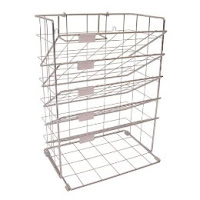
When I first started researching what I would use, I thought perhaps metal wall files would work.
But when I looked at the prices, I decided against it. This one with seven pockets was $52, and since I needed about a dozen pockets, it was more than I wanted to spend.

Next, I found this set of mesh wall files from Target, only available online for around $35 for a set of two. I liked these. They either hang on the wall or stand on a surface.


I stopped in Stapes yesterday, just to see what they had. I found a set of 6 clear plastic stacking trays for $10. Since I have space in my first-floor closet to stack these, I decided to get them. I didn't want to wait for an online order, I don't have to open a file to put things away, and they were on sale. I don't think I would have gone for this option if they were to be seen all the time. But since they'll be hidden away in the closet, they work for me! They are sturdy enough to stack all twelve in one stack.


As you can see, I've labeled each tray: general mail, bills, receipts, shredding, my to do, my business receipts, my general business, my husband's to do, coupons, and those categories related to foster parenting. You might not need as many trays as we do, but if you find paper is cluttering up your home or office, this idea may help.

How do you manage incoming paper?


More on paper:

Managing Paper
Despite the Digital Age, Paper Consumption Keeps Growing! 10 Ways to Help Reverse the Trend.
Sorting Mail
Three Steps to Decluttering

Wednesday, October 21, 2009

Getting Organized for Winter - Swapping Out Seasonal Clothes


Where we live, here in Northeast Ohio, we seem to have skipped Fall this year. Today and tomorrow we're going to be in the high 60's, but then we're back down into the 40's and 50's! We've had almost no transition into chilly weather at all! So, we've swapped out our clothes a little early this year.

Fall is a great time to declutter and purge. First, go through your summer clothes as you take them out of your closet and drawers. Or, if all your clothes fit in one closet, move your summer clothes to be less accessible and your fall and winter clothes to be most accessible, if necessary. If you have closets like Paris Hilton (see related post below), however, you won't have to worry about moving anything. Purging might help, though! :)

Next, start on your winter clothes.
For both seasons of clothes, ask yourself: Do I love this article of clothing? Does it make me feel fabulous? Have I been waiting too long to get into this size? Is it out of date? Is it shabby? Have I worn it in the last year? Do the same with shoes, purses, belts, underwear and socks. Make sure you leave out a couple of summer outfits for those occasional warm days.

As you purge, place your unwanted items in a giveaway stack or in a throwaway stack. My husband fills up his collection of rags at this time of year!

Thrift stores appreciate getting fall items at the beginning of the season. (If you're really energetic, they are taking Christmas items now, too!) Make a list of your donated items for tax purposes. Salvation Army has a valuation guide for donations to help determine the value of your donated items.

Next, organize your clothing according to style (casual, dressy casual, dressy), type (pants, sweaters, etc.), length (short sleeve, 3/4 sleeve, long sleeve; long pants, capri length, etc.), and color - put like colors together in each category.

With a glance you can evaluate your shopping needs. When I moved my winter clothes to be more accessible, and made my summer clothes less accessible, I could see exactly what I had for the cooler seasons. And I realized that I needed to go shopping (oh darn!). Several items were faded or worn. Since we're off for a few days, my husband and I had a wonderful day yesterday of having lunch together and shopping.

When your closet is organized, getting dressed in the morning is so much easier!
Now your closet will have breathing room, too - your clothes will not get wrinkled from being too crowded. If you go through this routine each year, it becomes easier and easier!

What are your tips for swapping out seasonal clothes?


More on Closets:
How Paris Hilton Organizes her Closet
Donating Business Clothing for Job Interviews
Get Oranized Month 2009 - Organizing Your Clothes Closet
Get Organized Month - Decluttering Your Tops/Blouses/Shirts

Tuesday, October 20, 2009

Destressing Christmas, Part 4, 2009 - Organize Your Cleaning and Decorating


I love having people in over the holidays! But that means my house must be clean and, of course, I’ll want to decorate. If I wait until the last minute, though, I’m stressed! Here are a few thoughts to help avoid that stress:

Cleaning

- Determine cleaning chores that need to be done for the holidays. Parcel out chores over the weeks remaining before Christmas, starting with the ones that are long-lasting: cleaning the silver or the carpet, decluttering and purging, etc. Save the surface cleaning until closer to your events. Or, if you haven’t cleaned for a while, just get caught up on your cleaning and do it every week.

- If your list of chores seems too overwhelming, work on them in 15-minute segments and do them 2-4 times a day. If they are still too overwhelming, eliminate some! Enlist family/house members to help with the cleaning chores.

- This is not a time for major home repair, sewing projects, painting, or other major projects!


Decorating

When the time comes for decorating, here are a few hints:

- If you have a lot of decorating to do, prioritize your list and schedule the individual items on your list.

- As you decorate, remove your regular decorating accessories and put them in the boxes from which you took your Christmas decorating items. That way, you won’t have to remember where you put them. I have a friend who couldn’t find her regular decorating items for a couple of months after the holidays one year!

- Take this opportunity to purge any decorating items or holiday items you no longer need or want. A great time to declutter! By doing this, the number of boxes you must get out every year decreases.

- Make holiday decorating a family affair, using items that have sentimental value to family members. Warm up some apple cider and put on some music!

- When you put your Christmas items away, make a list of what you have – decorating items, wrapping supplies, paper products, cards, extra gift items, dishes, etc., so you don’t duplicate them. Also make a list of items you need to purchase for next year and pick them up during the sales, if possible. This is a great time of year to get holiday storage boxes at a reduced price, too.

Do you have some great cleaning or decorating ideas you'd like to pass on?


Related Posts:

Three Steps to Clever Cleaning

Destressing Christmas, Part I, 2009 - Thinking Through Your Expectations
Destressing Christmas, Part 2, 2009 - Thinking Through the Needs of Your Family and Friends
Destressing Christmas, Part 3, 2009 - Smart Gift-Giving


Monday, October 19, 2009

Functioning at Peak Performance by Planning Quiet Moments


Here's a challenging article from Brain Fitness which speaks to peak performance and creativity:

"In addition to a good night sleep and plenty of rest to enable the brain to consolidate information learned during the day, the brain
also benefits from quiet moments during the day.

A quiet moment does not involve any goal, task completion, or endpoint. It is about process and about being in the here and now. A quiet moment can occur anywhere at any time so long as you permit your brain to shut down and to turn inward.

Removing structure and demand from your existence enables your brain to freely roam and to explore ideas and feelings that get shut out with structure and task driven behavior. Your most creative moments will come from such experiences.

It is not easy to create quiet moments. You need to establish parts of your day when you remove all chores, all responsibilities, and all task demands. It is simply time to be, for you to exist. It might mean a walk, sitting on a bench or under a tree, or playing an instrument. There is no conscious deliberation, it is meditative and introspective.

Sounds easy, but it is not. Give it a try and perhaps you will get in touch with your creative side!"

Comments?


More on Peak Performance:

Getting a Good Night's Sleep Despite Daylight Savings

Insuring Peak Performance: Sleep 101

Increasing Efficiency


Friday, October 16, 2009

Priorities and Perspective from a Ninety-Year-Old

My brother sent this to me, and I thought it was a great reminder about what is important in life. It was written by Regina Brett, 90 years old, of the Plain Dealer newspaper in Cleveland, Ohio.

"To celebrate growing older, I once wrote the 45 lessons life taught me. It is the most-requested column I've ever written.
My odometer rolled over to 90 in August, so here is the column once more:

1. Life isn't fair, but it's still good.

2. When in doubt, just take the next small step.

3. Life is too short to waste time hating anyone.

4. Your job won't take care of you when you are sick. Your friends and parents will. Stay in touch.

5. Pay off your credit cards every month.

6. You don't have to win every argument. Agree to disagree.

7. Cry with someone. It's more healing than crying alone.

8. It's OK to get angry with God. He can take it.

9. Save for retirement starting with your first paycheck.

10. When it comes to chocolate, resistance is futile.

11. Make peace with your past so it won't screw up the present.

12. It's OK to let your children see you cry.

13. Don't compare your life to others. You have no idea what their journey is all about.

14. If a relationship has to be a secret, you shouldn't be in it.

15. Everything can change in the blink of an eye. But don't worry; God never blinks.

16. Take a deep breath. It calms the mind.

17. Get rid of anything that isn't useful, beautiful or joyful.

18. Whatever doesn't kill you really does make you stronger..

19. It's never too late to have a happy childhood. But the second one is up to you and no one else

20. When it comes to going after what you love in life, don't take no for an answer.

21. Burn the candles, use the nice sheets, wear the fancy lingerie. Don't save it for a special occasion. Today is special.

22. Over prepare, then go with the flow.

23. Be eccentric now. Don't wait for old age to wear purple.

24. The most important sex organ is the brain.

25. No one is in charge of your happiness but you.

26.. Frame every so-called disaster with these words 'In five years, will this matter?'

27. Always choose life.

28. Forgive everyone for everything.

29. What other people think of you is none of your business.

30. Time heals almost everything. Give time time.

31. However good or bad a situation is, it will change.

32. Don't take yourself so seriously. No one else does.

33. Believe in miracles.

34. God loves you because of who God is, not because of anything you did or didn't do.

35. Don't audit life. Show up and make the most of it now.

36. Growing old beats the alternative -- dying young.

37. Your children get only one childhood.

38. All that truly matters in the end is that you loved.

39. Get outside every day. Miracles are waiting everywhere.

40. If we all threw our problems in a pile and saw everyone else's, we'd grab ours back.

41. Envy is a waste of time. You already have all you need.

42. The best is yet to come....

43. No matter how you feel, get up, dress up and show up.

44. Yield.

45. Life isn't tied with a bow, but it's still a gift."


My favorites: #10, 17 . What are yours?


More on priorities:

Your Priorities, Passions, and Gifts Create Context for Your Clutter

Getting Organized for School - Determining the Legacy You Want to Leave

Reduce Your Stress - Say No


Thursday, October 15, 2009

Organizing Your Shoes


Our closet has been driving me nuts. During our move, it had been a repository for miscellaneous things that didn't have a home yet. But my shoes were the things that were creating the biggest part of the mess! I got rid of items that didn't belong in this closet and moved on to my shoes.

In our previous closet, we had long shelves that held my shoes - they were all accessible all the time. Our current closet has a shoe rack at the bottom of the hanging clothes, but it doesn't come close to handling my shoes! I don't consider the number of my shoes to be excessive, but with winter boots, athletic shoes, summer shoes, winter shoes, and slippers, it adds up!

I decided to get a bunch of clear shoe boxes ($.94 at Walmart!). If I could get two pairs of shoes in one box, so much the better. I stored like colors together, like seasons together. Even though the boxes are clear, I plan to label the boxes, as dark shoes are not always recognizable.

This allows me to stack two boxes on each of the two shelves above my hanging clothes. Shoes that I wear a few times a year for special occasions are on the top shelf - less reachable since I don't need them often. My out of season shoes are reachable on the shelf just above my clothes - in case the weather changes suddenly. And my in-season shoes are on the shoe rack below my clothes, easily accessible.

To be more ecologically sensitive, I'll start keeping my shoe boxes when I buy new shoes. They usually have the picture of the shoe on the end, eliminating the need to label the boxes.

We all have different closets and different needs, but the same principles apply:
- get rid of anything you don't need
- keep those shoes you use often most easily accessible
- store other shoes according to your need to access them (less used, farthest away, etc.).

How wonderful to be able to navigate my closet without tripping over my shoes! I'm sure my husband appreciates it, too. :) While there, I organized the rest of the closet using the principles above. It only took about an hour total!

How do you organize your shoes?


More on closets:

Get Organized Month - Organize Your Shoes
Get Oranized Month 2009 - Organizing Your Clothes Closet
Swapping Out and Purging Your Seasonal Clothes


Wednesday, October 14, 2009

Destressing Christmas, Part 3, 2009 - Smart Gift-Giving


My brother loves the crowds and the hustle and bustle of holiday shopping. I don’t know many others who do, though! I am stressed if I have to elbow my way through a store or not be able to find what I want because I waited too late. If you are smart, you can make holiday gift-giving less stressful. Here are a few ideas:

- Make a master list of gifts you need to buy or make along with a budget for the amount you want to spend. Stick to your budget and don't buy impulsively. Don't compete with family and friends - spend what you can afford.

- Set a deadline for finishing your shopping in order to avoid crowds, the last-minute rush, and poor selection. Remember those gifts for teachers, religious teachers, extra-curricular instructors, and stocking stuffers. Buy the same gift for several people on your list, if appropriate. Take advantage of the sales after Christmas to shop for next year's list.


- Plan your shopping trips. What stores might have most of your gifts? What is the most efficient route to the stores on your list? A little planning avoids backtracking, saving time and gas.

- Consider gift certificates that can be sent to the recipients via email or U.S. mail. Or shop online and have your purchases sent directly to the recipients. You don’t have to wrap either of these gifts!

- If you're into making your own Christmas gifts, mass produce a gift and give it to as many people on your list as possible. To reduce stress, choose a gift that doesn't have to be made at the last minute. Create deadlines for each stage of production, if applicable, so you’re finished in plenty of time.

- As you buy or make gifts, wrap them so you don't have a massive pile to do at one time. Use TV time or other mindless time to wrap. How efficient - you're doubling your time!

- Your children will be bombarded with commercial after commercial during the holiday season, and they may want it all! Have a conversation with them about realistic expectations, so they won't be disappointed. Make gift suggestions to relatives who are shopping for your children.


If you want to get away from expensive or excessive gifts, consider alternative ideas:

- Instead of exchanging gifts, experience an event together: a day trip, a service project, a holiday event, etc.

- Take the money you would have spent on gifts for each other and donate it to a cause or your favorite charity or a needy family. My parents live in Oklahoma and the year of the bombing of the federal building in Oklahoma City, they asked us to donate to The Salvation Army in their names, as that organization was so instrumental in helping during the aftermath.

- Consider drawing names or doing a "nice" white elephant game with a dollar limit on the gift.

- Give gift certificates of your time or service: babysitting, cleaning, meal preparation, handyman work, running errands, etc.

- Consider a “buy nothing” Christmas. This site gives scores of ideas from people who want to leave no footprint on the earth. Last year we gave home-grown herbs from our garden to some of our family and friends.

- With some friends or family, you may want to call a moratorium on gifts, especially when you get to the point of not needing anything. If it’s the thought that counts, try writing your thoughts down and giving them a note or letter expressing your gratitude for their friendship or love.

The holidays can be a stressful time. With a little planning, you can reduce the stress of holiday shopping and enjoy blessing your friends - without straining your budget or your temper!

What are your creative gift-giving ideas?


More on destressing Christmas:

Destressing Christmas, Part I, 2009 - Thinking Through Your Expectations
Destressing Christmas, Part 2, 2009 - Thinking Through the Needs of Your Family and Friends
Toy decluttering