Friday, October 23, 2009
Information that Simplifies Your Life
I thought you might find this information useful in simplifying your life:
- Still Tasty: Still Tasty, the ultimate shelf-life guide, answers these questions: How long will your favorite food or beverage stay safe and tasty? What's the best way to store it?
- 800-GOOG-411: "If I need a business phone number and I'm not by a computer to look it up online, I call Google's free directory information service at 800-GOOG-411. Doing this, say, four times a month, instead of paying the usual $1.25 per call, saves $60 a year - in my mind, that's a 'free' dinner-and-a-movie date with my husband." (Donna Gallo Weppler, Articles Director, Family Circle Magazine November 1, 2009, p. 15)
- Trackle: "Trackle.com is a cool new site that can track - hence the name - stuff like local swine flu outbreaks, concerts and airfairs," says Contributing Tech Editor Christina Tynan-Wood. 'Right now I'm tracking a purse on eBags - Trackle will e-mail me if the price drops. I just had to set up a free account, then create "Personal Tracklets" for what I want to follow. The software does my virtual legwork.'" (Family Circle Magazine, November 1, 2009, p. 15)
Share with us information that simplifies your life!
More on information that simplifies your life:
Decluttering Mail and Phone Calls
More Family Organizing Sites
More Eco-Friendly Recycling
Three Steps to Decluttering


Thursday, October 22, 2009
Creating an Incoming Paper Hub
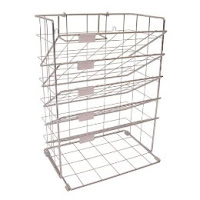
Paper = clutter! At least in my humble opinion! With our office being in our basement, I know that every time I process a piece of paper, I'm not going down to the basement to do it. So I've created an interim incoming paper hub. When I first started researching what I would use, I thought perhaps metal wall files would work.
 But when I looked at the prices, I decided against it. This one with seven pockets was $52, and since I needed about a dozen pockets, it was more than I wanted to spend.
Next, I found this set of mesh wall files from Target, only available online for around $35 for a set of two. I liked these. They either hang on the wall or stand on a surface.
 I stopped in Stapes yesterday, just to see what they had. I found a set of 6 clear plastic stacking trays for $10. Since I have space in my first-floor closet to stack these, I decided to get them. I didn't want to wait for an online order, I don't have to open a file to put things away, and they were on sale. I don't think I would have gone for this option if they were to be seen all the time. But since they'll be hidden away in the closet, they work for me! They are sturdy enough to stack all twelve in one stack.
As you can see, I've labeled each tray: general mail, bills, receipts, shredding, my to do, my business receipts, my general business, my husband's to do, coupons, and those categories related to foster parenting. You might not need as many trays as we do, but if you find paper is cluttering up your home or office, this idea may help.
How do you manage incoming paper?
More on paper:
Managing Paper
Despite the Digital Age, Paper Consumption Keeps Growing! 10 Ways to Help Reverse the Trend.
Sorting Mail
Three Steps to Decluttering
Wednesday, October 21, 2009
Getting Organized for Winter - Swapping Out Seasonal Clothes
Where we live, here in Northeast Ohio, we seem to have skipped Fall this year. Today and tomorrow we're going to be in the high 60's, but then we're back down into the 40's and 50's! We've had almost no transition into chilly weather at all! So, we've swapped out our clothes a little early this year.
Fall is a great time to declutter and purge. First, go through your summer clothes as you take them out of your closet and drawers. Or, if all your clothes fit in one closet, move your summer clothes to be less accessible and your fall and winter clothes to be most accessible, if necessary. If you have closets like Paris Hilton (see related post below), however, you won't have to worry about moving anything. Purging might help, though! :)
Next, start on your winter clothes. For both seasons of clothes, ask yourself: Do I love this article of clothing? Does it make me feel fabulous? Have I been waiting too long to get into this size? Is it out of date? Is it shabby? Have I worn it in the last year? Do the same with shoes, purses, belts, underwear and socks. Make sure you leave out a couple of summer outfits for those occasional warm days.
As you purge, place your unwanted items in a giveaway stack or in a throwaway stack. My husband fills up his collection of rags at this time of year!
Thrift stores appreciate getting fall items at the beginning of the season. (If you're really energetic, they are taking Christmas items now, too!) Make a list of your donated items for tax purposes. Salvation Army has a valuation guide for donations to help determine the value of your donated items.
Next, organize your clothing according to style (casual, dressy casual, dressy), type (pants, sweaters, etc.), length (short sleeve, 3/4 sleeve, long sleeve; long pants, capri length, etc.), and color - put like colors together in each category.
With a glance you can evaluate your shopping needs. When I moved my winter clothes to be more accessible, and made my summer clothes less accessible, I could see exactly what I had for the cooler seasons. And I realized that I needed to go shopping (oh darn!). Several items were faded or worn. Since we're off for a few days, my husband and I had a wonderful day yesterday of having lunch together and shopping.
When your closet is organized, getting dressed in the morning is so much easier! Now your closet will have breathing room, too - your clothes will not get wrinkled from being too crowded. If you go through this routine each year, it becomes easier and easier!
What are your tips for swapping out seasonal clothes?
More on Closets:
How Paris Hilton Organizes her Closet
Donating Business Clothing for Job Interviews
Get Oranized Month 2009 - Organizing Your Clothes Closet
Get Organized Month - Decluttering Your Tops/Blouses/Shirts
Tuesday, October 20, 2009
Destressing Christmas, Part 4, 2009 - Organize Your Cleaning and Decorating
I love having people in over the holidays! But that means my house must be clean and, of course, I’ll want to decorate. If I wait until the last minute, though, I’m stressed! Here are a few thoughts to help avoid that stress:
Cleaning
- Determine cleaning chores that need to be done for the holidays. Parcel out chores over the weeks remaining before Christmas, starting with the ones that are long-lasting: cleaning the silver or the carpet, decluttering and purging, etc. Save the surface cleaning until closer to your events. Or, if you haven’t cleaned for a while, just get caught up on your cleaning and do it every week.
- If your list of chores seems too overwhelming, work on them in 15-minute segments and do them 2-4 times a day. If they are still too overwhelming, eliminate some! Enlist family/house members to help with the cleaning chores.
- This is not a time for major home repair, sewing projects, painting, or other major projects!
Decorating
When the time comes for decorating, here are a few hints:
- If you have a lot of decorating to do, prioritize your list and schedule the individual items on your list.- As you decorate, remove your regular decorating accessories and put them in the boxes from which you took your Christmas decorating items. That way, you won’t have to remember where you put them. I have a friend who couldn’t find her regular decorating items for a couple of months after the holidays one year!
- Take this opportunity to purge any decorating items or holiday items you no longer need or want. A great time to declutter! By doing this, the number of boxes you must get out every year decreases.
- Make holiday decorating a family affair, using items that have sentimental value to family members. Warm up some apple cider and put on some music!
- When you put your Christmas items away, make a list of what you have – decorating items, wrapping supplies, paper products, cards, extra gift items, dishes, etc., so you don’t duplicate them. Also make a list of items you need to purchase for next year and pick them up during the sales, if possible. This is a great time of year to get holiday storage boxes at a reduced price, too.
Do you have some great cleaning or decorating ideas you'd like to pass on?
Related Posts:
Three Steps to Clever Cleaning
Destressing Christmas, Part I, 2009 - Thinking Through Your Expectations
Destressing Christmas, Part 2, 2009 - Thinking Through the Needs of Your Family and Friends
Destressing Christmas, Part 3, 2009 - Smart Gift-Giving
Monday, October 19, 2009
Functioning at Peak Performance by Planning Quiet Moments
Here's a challenging article from Brain Fitness which speaks to peak performance and creativity:
"In addition to a good night sleep and plenty of rest to enable the brain to consolidate information learned during the day, the brain also benefits from quiet moments during the day.
A quiet moment does not involve any goal, task completion, or endpoint. It is about process and about being in the here and now. A quiet moment can occur anywhere at any time so long as you permit your brain to shut down and to turn inward.
Removing structure and demand from your existence enables your brain to freely roam and to explore ideas and feelings that get shut out with structure and task driven behavior. Your most creative moments will come from such experiences.
It is not easy to create quiet moments. You need to establish parts of your day when you remove all chores, all responsibilities, and all task demands. It is simply time to be, for you to exist. It might mean a walk, sitting on a bench or under a tree, or playing an instrument. There is no conscious deliberation, it is meditative and introspective.
Sounds easy, but it is not. Give it a try and perhaps you will get in touch with your creative side!"
Comments?
Getting a Good Night's Sleep Despite Daylight Savings
Insuring Peak Performance: Sleep 101
Friday, October 16, 2009
Priorities and Perspective from a Ninety-Year-Old
My brother sent this to me, and I thought it was a great reminder about what is important in life. It was written by Regina Brett, 90 years old, of the Plain Dealer newspaper in Cleveland, Ohio.
"To celebrate growing older, I once wrote the 45 lessons life taught me. It is the most-requested column I've ever written.My odometer rolled over to 90 in August, so here is the column once more:
1. Life isn't fair, but it's still good.
2. When in doubt, just take the next small step.
3. Life is too short to waste time hating anyone.
4. Your job won't take care of you when you are sick. Your friends and parents will. Stay in touch.
5. Pay off your credit cards every month.
6. You don't have to win every argument. Agree to disagree.
7. Cry with someone. It's more healing than crying alone.
8. It's OK to get angry with God. He can take it.
9. Save for retirement starting with your first paycheck.
10. When it comes to chocolate, resistance is futile.
11. Make peace with your past so it won't screw up the present.
12. It's OK to let your children see you cry.
13. Don't compare your life to others. You have no idea what their journey is all about.
14. If a relationship has to be a secret, you shouldn't be in it.
15. Everything can change in the blink of an eye. But don't worry; God never blinks.
16. Take a deep breath. It calms the mind.
17. Get rid of anything that isn't useful, beautiful or joyful.
18. Whatever doesn't kill you really does make you stronger..
19. It's never too late to have a happy childhood. But the second one is up to you and no one else
20. When it comes to going after what you love in life, don't take no for an answer.
21. Burn the candles, use the nice sheets, wear the fancy lingerie. Don't save it for a special occasion. Today is special.
22. Over prepare, then go with the flow.
23. Be eccentric now. Don't wait for old age to wear purple.
24. The most important sex organ is the brain.
25. No one is in charge of your happiness but you.
26.. Frame every so-called disaster with these words 'In five years, will this matter?'
27. Always choose life.
28. Forgive everyone for everything.
29. What other people think of you is none of your business.
30. Time heals almost everything. Give time time.
31. However good or bad a situation is, it will change.
32. Don't take yourself so seriously. No one else does.
33. Believe in miracles.
34. God loves you because of who God is, not because of anything you did or didn't do.
35. Don't audit life. Show up and make the most of it now.
36. Growing old beats the alternative -- dying young.
37. Your children get only one childhood.
38. All that truly matters in the end is that you loved.
39. Get outside every day. Miracles are waiting everywhere.
40. If we all threw our problems in a pile and saw everyone else's, we'd grab ours back.
41. Envy is a waste of time. You already have all you need.
42. The best is yet to come....
43. No matter how you feel, get up, dress up and show up.
44. Yield.
45. Life isn't tied with a bow, but it's still a gift."
My favorites: #10, 17 . What are yours?
Your Priorities, Passions, and Gifts Create Context for Your Clutter
Getting Organized for School - Determining the Legacy You Want to Leave
Thursday, October 15, 2009
Organizing Your Shoes
Our closet has been driving me nuts. During our move, it had been a repository for miscellaneous things that didn't have a home yet. But my shoes were the things that were creating the biggest part of the mess! I got rid of items that didn't belong in this closet and moved on to my shoes.
In our previous closet, we had long shelves that held my shoes - they were all accessible all the time. Our current closet has a shoe rack at the bottom of the hanging clothes, but it doesn't come close to handling my shoes! I don't consider the number of my shoes to be excessive, but with winter boots, athletic shoes, summer shoes, winter shoes, and slippers, it adds up!
I decided to get a bunch of clear shoe boxes ($.94 at Walmart!). If I could get two pairs of shoes in one box, so much the better. I stored like colors together, like seasons together. Even though the boxes are clear, I plan to label the boxes, as dark shoes are not always recognizable.
This allows me to stack two boxes on each of the two shelves above my hanging clothes. Shoes that I wear a few times a year for special occasions are on the top shelf - less reachable since I don't need them often. My out of season shoes are reachable on the shelf just above my clothes - in case the weather changes suddenly. And my in-season shoes are on the shoe rack below my clothes, easily accessible.
To be more ecologically sensitive, I'll start keeping my shoe boxes when I buy new shoes. They usually have the picture of the shoe on the end, eliminating the need to label the boxes.
We all have different closets and different needs, but the same principles apply:
- get rid of anything you don't need
- keep those shoes you use often most easily accessible
- store other shoes according to your need to access them (less used, farthest away, etc.).
How wonderful to be able to navigate my closet without tripping over my shoes! I'm sure my husband appreciates it, too. :) While there, I organized the rest of the closet using the principles above. It only took about an hour total!
How do you organize your shoes?
More on closets:
Get Organized Month - Organize Your Shoes
Get Oranized Month 2009 - Organizing Your Clothes Closet
Swapping Out and Purging Your Seasonal Clothes
Wednesday, October 14, 2009
Destressing Christmas, Part 3, 2009 - Smart Gift-Giving
My brother loves the crowds and the hustle and bustle of holiday shopping. I don’t know many others who do, though! I am stressed if I have to elbow my way through a store or not be able to find what I want because I waited too late. If you are smart, you can make holiday gift-giving less stressful. Here are a few ideas:
- Make a master list of gifts you need to buy or make along with a budget for the amount you want to spend. Stick to your budget and don't buy impulsively. Don't compete with family and friends - spend what you can afford.
- Set a deadline for finishing your shopping in order to avoid crowds, the last-minute rush, and poor selection. Remember those gifts for teachers, religious teachers, extra-curricular instructors, and stocking stuffers. Buy the same gift for several people on your list, if appropriate. Take advantage of the sales after Christmas to shop for next year's list.
- Plan your shopping trips. What stores might have most of your gifts? What is the most efficient route to the stores on your list? A little planning avoids backtracking, saving time and gas.
- Consider gift certificates that can be sent to the recipients via email or U.S. mail. Or shop online and have your purchases sent directly to the recipients. You don’t have to wrap either of these gifts!
- If you're into making your own Christmas gifts, mass produce a gift and give it to as many people on your list as possible. To reduce stress, choose a gift that doesn't have to be made at the last minute. Create deadlines for each stage of production, if applicable, so you’re finished in plenty of time.
- As you buy or make gifts, wrap them so you don't have a massive pile to do at one time. Use TV time or other mindless time to wrap. How efficient - you're doubling your time!
- Your children will be bombarded with commercial after commercial during the holiday season, and they may want it all! Have a conversation with them about realistic expectations, so they won't be disappointed. Make gift suggestions to relatives who are shopping for your children.
If you want to get away from expensive or excessive gifts, consider alternative ideas:
- Instead of exchanging gifts, experience an event together: a day trip, a service project, a holiday event, etc.
- Take the money you would have spent on gifts for each other and donate it to a cause or your favorite charity or a needy family. My parents live in Oklahoma and the year of the bombing of the federal building in Oklahoma City, they asked us to donate to The Salvation Army in their names, as that organization was so instrumental in helping during the aftermath.
- Consider drawing names or doing a "nice" white elephant game with a dollar limit on the gift.
- Give gift certificates of your time or service: babysitting, cleaning, meal preparation, handyman work, running errands, etc.
- Consider a “buy nothing” Christmas. This site gives scores of ideas from people who want to leave no footprint on the earth. Last year we gave home-grown herbs from our garden to some of our family and friends.
- With some friends or family, you may want to call a moratorium on gifts, especially when you get to the point of not needing anything. If it’s the thought that counts, try writing your thoughts down and giving them a note or letter expressing your gratitude for their friendship or love.
The holidays can be a stressful time. With a little planning, you can reduce the stress of holiday shopping and enjoy blessing your friends - without straining your budget or your temper!
What are your creative gift-giving ideas?
More on destressing Christmas:
Destressing Christmas, Part I, 2009 - Thinking Through Your Expectations
Destressing Christmas, Part 2, 2009 - Thinking Through the Needs of Your Family and Friends
Toy decluttering
Tuesday, October 13, 2009
Grand Opening for Mom Audience Marketplace!
I'm very excited to announce the Grand Opening of Mom Audience Marketplace, where you can buy and sell products that appeal to moms.
Mom Audience Marketplace narrows down your search whether you're buying or selling. Our mom audience subscribers are looking mom-appealing products. And, if you sell products that appeal to moms, we have a captivated audience of moms!
If you have a product to sell, you can get double exposure by listing your product on our Mom Audience weekly email, too. It's free!
For all the details, go to MomAudience.com.
Clever Corner Storage
Here's another idea from Better Homes and Gardens - using your corners for efficient organizing or storage. This example is for the bathroom, but it would work in any room where you have an extra corner lurking around and need some cute storage.
"Make use of corner space with a tall pot rack. Fill bowls with bathroom supplies and stacks of rolled bath towels for an attractive and functional display."
You could substitute baskets for the bowls and store whatever you need in that room: sewing items in a craft room, fresh produce in the kitchen, etc.

Share your ideas!
Finding More Bathroom Storage without Expanding Your Bathroom
Get Organized Month 2009 - #1 Biggest Organizing Mistake
Magnetic Paint - An Innovative Space Saver!
Monday, October 12, 2009
Getting Organized for School - Organizing Your Child's Artwork and School Papers
Are you overwhelmed with school papers yet? Here's a blog I did last year to help corral the overload ...
Along with school, comes all those papers! And art masterpieces. What to do with them? You want to preserve memories of your child’s school years, but you don’t want to train her to be a pack rat.
I’ll have to admit – I wasn’t very proactive in this area when my children were growing up. We’d sort through papers every once in a while, frame some, and store others, but we didn’t do it very consistently.
I researched this topic when asked to contribute to an article written by Mary Beth Breckenridge at the Akron Beacon Journal (Preserve your Children's Masterpieces without Creating a Mountain from Paper Memoirs, September 5, 2005). I found some great ideas I wish I had used.
So today’s blog comes primarily from the article Mary Beth wrote from the hints that two other organizers (Deniece Schofield and Chris Perrow) and I contributed. And I’ve added a couple I’ve come up with since then.
First, choose a receptacle for such papers. It could be a file folder, a hanging file, an art portfolio (or one made by taping two pieces of poster board together), a box, a binder with protector sheets - whatever works for you and your child.
Before storing your child’s artwork, you may want to display them. You could create a gallery in your child’s room or elsewhere by hanging a colorful piece of string or yarn across a wall and clip the artwork to the string. Voila – instant gallery.
Or use a picture frame to house artwork, swapping out the front picture when a new keeper comes along, storing the other pictures behind the most recent one. And there’s always the refrigerator or a bulletin board.
Another option is to turn the artwork into placemats (by laminating them), wrapping paper or greeting cards. A glass-covered coffee table can show off artwork under the glass. Or turn your child’s artwork into a calendar. Create a collage with several pieces of artwork. There are even companies that turn your child’s artwork into a book.
Artwork that doesn’t make it into the keeper file can be sent to grandma or to our troops, if it seems too cruel to toss them.
With your child, clean out her backpack at the end of the week. Some papers will not be sentimental and will go easily into the recycling bin. Try to encourage your child to choose only one item a week to keep. Label the back of the paper with the date and a description, especially if the picture may not be readily identifiable!
Some weeks may be more prolific than others, and it may be too traumatic to narrow it down to one item. If you don’t mind, and you have enough room, make exceptions here and there. There may be items you treasure, but your child doesn’t see the value in them at her age – keep those, too.
At the end of the month, as you are evaluating that week’s papers, look back over the previously stored papers to see if some of the sentimentality has decreased for the earlier keepers. Time has a way of diminishing the attachment. Repeat every month.
For large three-dimensional projects take a picture rather than storing the entire project. Large art pieces can be taken to a copy center and reduced to a manageable size.
At the end of the school year, determine if your storage is adequate to house that year’s keepers. If not, purge until it is. Label the container with your child’s name and the year.
For family night one night, take out the keepers for the last few years and reminisce – what a fun memory!
Friday, October 9, 2009
Despite the Digital Age, Paper Consumption Keeps Growing! 10 Ways to Help Reverse the Trend.
According to Ann Mulcahy, Xerox CEO ("Paper Trail," Wall Street Journal interview, 3/9/09), paper has continued to grow over the last thirty years, with the printing of emails being a major culprit.
You would think that our paper consumption would decrease with the use of the internet, right? Yet 95% of all information is still processed in paper form according to Frank Booty ("Managing the Paper Trail," Systems I New UK, 3/01/07).
What can we do to reverse this trend? Here are a few suggestions:
1. Don't print emails or other digital products. Instead, file them on your computer if you need to keep the information. Create folders on your email account or copy the document and file it with your computer documents. Daniel Lyons reports that more than 40% of printouts are discarded within 24 hours, according to Xerox research ("The Paper Chasers," Newsweek 12/01/09).
2. Pay bills online. Not only does this save paper, but it saves time and money. It's so much easier to click than write a check, mail it, etc. And it's cheaper to process digital transactions than paper ones.
3. Ask investment firms, catalog companies, phone books companies, and others to stop mailing their information to you. Otherwise you may be deluged with quarterly reports, catalogs and other printed materials that you will inevitably toss.
4. Re-use paper that has been printed on only one side. For items that need not be in pristine condition, print on the blank side of these papers. Test runs, maps, drafts, and other such items are great candidates for eco-friendly printing. Just make sure that papers containing confidential information are not used for this task!
5. Keep track of the printed information you must keep in order to avoid replacing it. According to the Delphi Group out of Boston, 15% of all paper handled in business is lost, as reported by Jane M. Von Bergen (Knight Ridder Newspapers, The Boston Globe, 3/21/2006).
6. Recycle! According to Mike McConnell, all paper types can be recycled. ("Talking Trash," Journal of Property Management, 7/01/07 Statistic, EPA). Designate recycle containers both at work and at home for paper products.
If your area does not recycle (shame on them!), find the nearest recycle center. Many schools have such containers. Or find a company that will collect your paper products. Shredding companies will periodically offer free shredding of sensitive documents, as well.
7. Use recycled paper products. Not only toilet paper, napkins and paper bags, but computer paper, too! Look for the recycle symbol on the products you buy.
8. Use cloth instead of paper napkins, paper towels, and diapers whenever possible.
9. Use washable plates, glasses and mugs instead of disposable paper products as much as possible.
10. Reduce paper consumption and clutter by reading newspapers and magazines online rather than in print version. Or share a subscription with someone else. Buy ebooks when available.
Give us your eco-friendly suggestions!
Thursday, October 8, 2009
Creating a Cleaning List
Our new home is quite a bit larger than our previous one. So my husband and I have made a new list of cleaning duties. There are several different cleaning philosophies, one of which is doing a little each day - that's the one we prefer these days. We have used others in the past, but this is the one that works for us right now.
When making our list, we considered what else was going on that day. We divided up the chores, including outdoor work. Now we each have a cleaning task(s) to do each day. We also made a list of monthly cleaning jobs and decided when to do those.
I like to do my cleaning in the afternoons when the girls are home from school. I can be interrupted and can chat with the girls while cleaning. That allows me to use the times when they are not at home for other work which is best done without being interrupted. My husband, on the other hand, likes to do his cleaning first thing in the morning to get it off his mind.
I've posted our list on our refrigerator so we can be reminded of our new schedule. I think it's good, too, for the girls to see what it takes to keep a home running well.
If you're feeling at a loss of where to start, my book Three Steps to Clever Cleaning helps you determine your cleaning philosophy and gives tips for streamlining your cleaning so you can get on to more fun stuff! It also provides a schedule for infrequent cleaning chores.
I know there are those out there who love to clean and I applaud you! But alas, I'm not one of those. I do love a clean house, though, and am willing to spend the time to keep it that way. Plus I'm sending a subliminal message to my foster daughters that they are important enough to me to provide them with a clean and attractive place to live. It's part of my desire to create an atmosphere for their success.
What are your cleaning secrets?
More on cleaning:
Schedule Daily Clean Up Times
The Best Time of Day to Clean the House
Get Organized Month 2009 - Family Five Minute Challenge
Wednesday, October 7, 2009
Getting Organized for School - Charts
As permanent houseparents for our foster daughters, we are trying to create structures and routines for their success. One is pretty structured on her own, but the other is a creative, free spirit. She is so much more interested in how she looks than whether she has all her books in her book bag!
After many attempts at creating a routine, I decided to go with a chart - one part for the morning and one part for after school/evening. I've broken it down to individual tasks - getting up with the alarm, getting dressed, doing hair, eating breakfast, etc. in the morning, and homework, loading her book bag, playing, dinner, chores, shower, etc. for the afternoon and evening.
Now our free spirit doesn't have to think about what needs to be done, she just looks at her chart. We tried it out yesterday, and she did so well that she had extra time to read. She wasn't too thrilled about the chore part, though. But it's better than saving chores up until Saturday and having endless work!
I divided her chores up into bite-size pieces: dusting, vacuuming, toilet, counter, bathroom floor, washing one load of laundry one day, drying it and putting it away the next, etc.
I haven't asked her yet if she wants to put stickers on her chart - I won't be surprised either way. She is 13 after all, but she's still a little kid, too!
How do you create routines and structure for yourself and/or your family?
More on routines:
Getting Organized for School - Start the Night Before
Creating Routines and Systems
The Real Problems Behind Kids' Excuses To Get Out of Chores
Tuesday, October 6, 2009
Destressing Christmas, Part 2, 2009 - Thinking Through the Needs of Your Family and Friends
As I mentioned last week, I'm going to be updating my Destressing Christmas series this year. If I calculate correctly, we are 78 days away from Christmas. So let's look at another way to destress Christmas: thinking about the needs of your family and friends. By using this as a filter, you can reduce some holiday stress. Here are some ideas:
- Choose whom you want to spend time with over the holidays - friends or family who refresh, encourage, and cheer you. Take the initiative to make that happen.
Do you have friends who might be alone whom you could include in your holiday plans? Have you included a healthy amount of giving to others who might otherwise be neglected? Your heart will overflow with joy as you reach out to others! It doesn't need to be expensive, just something that says you're thinking about them.
This makes me think of girls who have left our Shelter Care program but may not have anyone with whom to spend Christmas Day. I'll invite them this week for both Thanksgiving and Christmas.
If getting together with your relatives is too painful or unhealthy, give yourself permission not to attend. If you, your spouse, or your children might be subjected to verbal, emotional or physical abuse, don't put yourselves in this unsafe place. Even if it hurts others' feelings, you cannot condone unhealthy or painful treatment by attending.
- Consider family problems when planning gatherings. Be proactive in order to minimize Uncle John's drinking problem by having a brunch rather than a dinner. If Cousin Sally's conversation is predominantly negative or a never-ending flow, plan some conversation starters or games to reduce her dominance.
- If it's just too difficult for you to travel during the holidays, don't let others guilt-trip you into travelling anyway. Be honest and stick to your guns for your own benefit and that of your family. Invite your relatives to visit you (if that is better for you) or suggest another time of year for a visit when life is less hectic.
- Consider the needs of your nuclear family. If you have small children who need naps and a consistent bedtime (who doesn’t qualify for that one?!!), don’t overschedule. Make sure the events you plan to attend are age appropriate for your children. Don’t have an unrealistic idea of what they can grasp and endure.
- Study your family. Know what delights each one and what stresses each one, including yourself. Plan accordingly. When our girls were small, one of our daughters would respond to an overplanned schedule by vomiting - a pretty clear message! (Sorry to be graphic.) So I had to be careful not to pack our schedule too tightly.
One of our daughters loved to help my husband get the tree in the stand and put the lights on. The other one did not! So we did not include it as a family event, but chose other things they both liked.
By anticipating your needs and those of your family and friends, you can be intentional about your holidays. You’ll be able to weed out those items that don’t fit, plan around potential hazards, and create memorable experiences for those you love.
What are your family's delights and stresses?
More on Christmas:
Destressing Christmas, Part I, 2009 - Thinking Through Your Expectations
Tackle the Clutter before Christmas
Three Steps to Clever Cleaning
Subscribe to:
Posts (Atom)


 Posts
Posts